Why We Sleep by Matthew Walker — a review
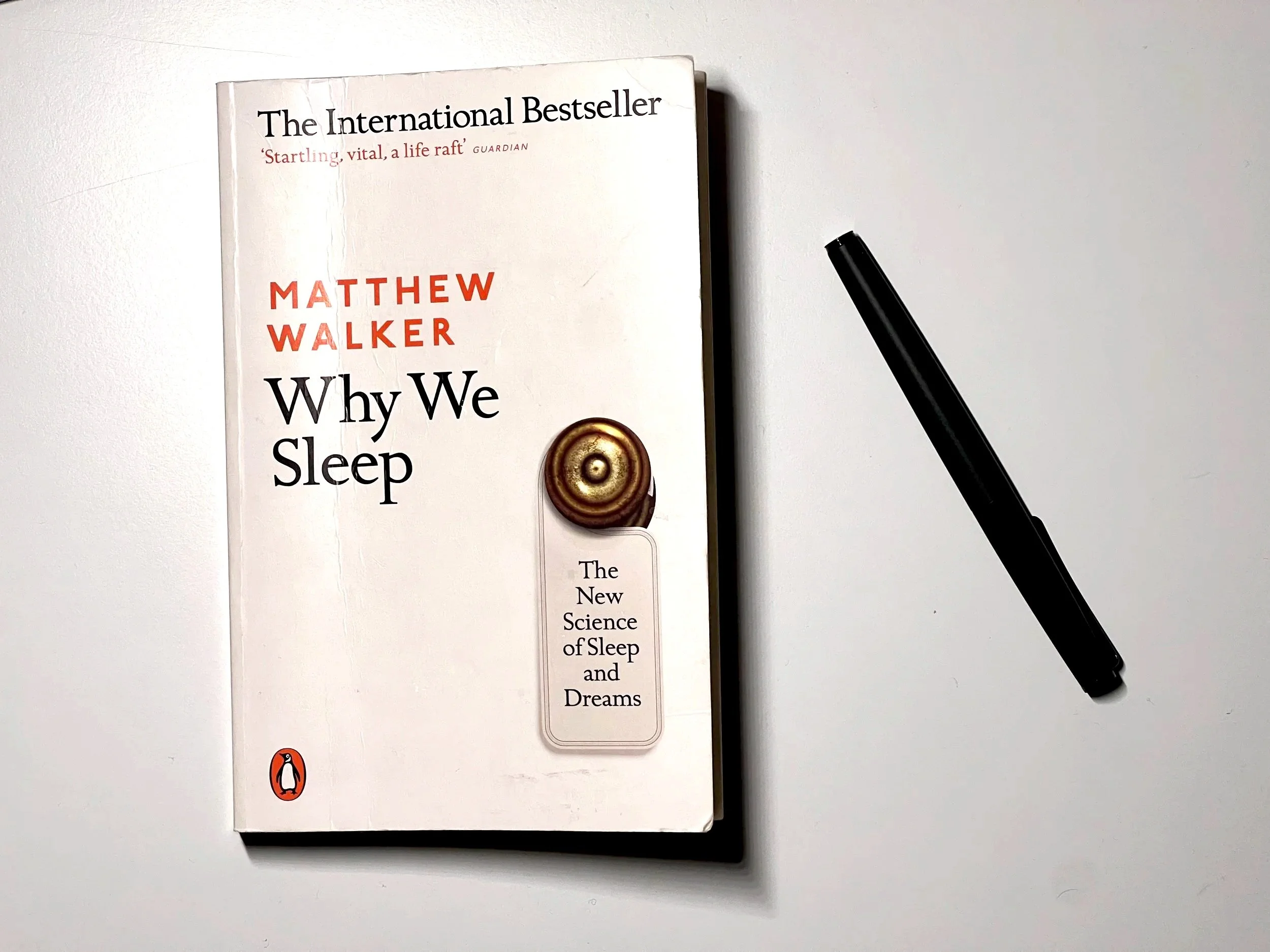
Sleeping is underrated.
I know this not from a book, but from a year of data on my wrist.
After reading Why We Sleep I bought a smartwatch. Not a serious one: a €35 Xiaomi, black, the cheapest model that tracked sleep. I didn't care about steps or heart rate zones or any of the rest. I wanted one number every morning: how did I sleep?
After twelve months of looking at that number, one pattern became impossible to ignore. A bad night shows up the next day as fog. Not tiredness exactly, more like the world is slightly out of focus, and I just want to get through the hours and start again tomorrow. A good night is the opposite. The thinking is faster. The frustration threshold is higher. The day feels like something I chose rather than something happening to me.
That's not a feeling. That's a measurement. Repeated enough times that I stopped arguing with it.
The other thing the book did: it changed my relationship with caffeine. I used to drink coffee the way most people in my field do, automatically, socially, as punctuation between meetings. I stopped. Completely, or nearly. I might drink ten coffees in a year now. When I do, I'm aware of what I'm trading. Walker explains the mechanism clearly enough that ignorance is no longer available as an excuse.
I started with the data. Walker gives you the science behind it. Here's what the book actually says.
How sleep works
The ideal pattern, according to Walker, is biphasic: seven to eight hours at night, plus a short nap of thirty to sixty minutes in the afternoon. Sleep moves through two primary phases.
NREM — non-rapid eye movement — is deep, restorative sleep. This is where your brain categorises and stores the experiences of the day, transferring them from short-term to long-term memory.
REM — rapid eye movement — is dreaming sleep. Here, your brain builds connections between new and old information, processes emotions, and generates the kind of lateral thinking that doesn't happen when you're awake and focused. Brain scans during REM show activity almost identical to wakefulness, while the body is essentially paralysed. This is the biological reason "sleep on it" is not a platitude. It is a mechanism.
Underneath both phases runs your circadian rhythm — a natural twenty-four-hour cycle tied to light and temperature, governing when you feel alert and when you fade. It operates whether or not you pay attention to it. Walker's argument is that you should pay attention to it.
What sleep actually does
Walker doesn't make the case for sleep in vague terms. He quantifies it.
A good night's sleep improves memory retention by twenty to forty percent. It helps the brain selectively preserve what matters and discard what doesn't. It boosts emotional regulation: your ability to read other people, to respond rather than react, to stay proportionate under pressure.
Physically, consistent sleep lowers the risk of cancer, heart disease, stroke, and dementia. It strengthens the immune system. It regulates appetite and metabolism. The list is long enough to feel implausible until you sit with it, and then it starts to feel like the most obvious thing in the world, of course the hours when your body repairs itself are the most important hours.
What happens when you don't
This is the section of the book that stays with you.
After sixteen hours awake, cognitive performance begins to decline measurably. After twenty-two hours, your brain performs at a level comparable to clinical intoxication. Losing two hours of sleep, going from eight to six, cuts sixty to ninety percent of your REM sleep. Not proportionally. Disproportionately.
Walker offers a simple diagnostic. Do you need caffeine to function before noon? Could you fall asleep easily at eleven in the morning if you sat quietly? Do you struggle to focus in the afternoon without a second coffee? If the answer to most of those is yes, you are sleep-deprived. Not tired. Deprived — which is a different category with different consequences.
Chronic sleep deprivation increases the risk of anxiety, depression, obesity, and diabetes. It produces microsleep episodes, brief, involuntary episodes of loss of consciousness. Extremely dangerous and explains a significant proportion of road accidents. The brain does not announce these episodes. You simply disappear for a moment and return.
What disrupts it
Three main culprits. Caffeine, alcohol, and screens.
Caffeine works by blocking adenosine, the chemical that accumulates in your brain throughout the day and creates the pressure to sleep. Caffeine doesn't remove the adenosine. It binds to receptors and prevents you from feeling it. When the caffeine clears, the adenosine floods back, which is why the post-caffeine crash feels worse than the original tiredness would have. The half-life of caffeine in the body is five to seven hours. A coffee at three in the afternoon is still half-present at eight or nine at night.
This is what made me stop. Not willpower. The mechanism. Once I understood what caffeine was actually doing, deferring tiredness rather than resolving it, quietly degrading the sleep I would have had, continuing felt like a strange choice.
Alcohol is similarly misunderstood. It is a sedative, not a sleep aid. It suppresses REM sleep, which means you may fall asleep faster, but you wake less restored. The grogginess of a morning after drinking is not dehydration. It is REM deprivation.
Screens and artificial light interfere with melatonin production and push your circadian rhythm later. Jet lag and shift work do the same more violently. Walker cites research showing they cause measurable structural damage to brain cells involved in memory.

Make it stand out
Different drug effects on web spider.
Source: NASA - Noever, R., J. Cronise, and R. A. Relwani. 1995. Using spider-web patterns to determine toxicity. NASA Tech Briefs 19(4):82. Published in New Scientist magazine, 29 April 1995. http://www.caffeineweb.com/?p=15, Public Domain.
What dreams are for
Dreams are not noise. Walker argues they serve a specific function: emotional processing.
REM sleep is the only state in which noradrenaline, the brain's primary stress chemical, is completely absent. This allows the brain to revisit difficult or emotionally charged experiences without the physiological stress response that accompanies them when awake. The experience is replayed; the charge is gradually reduced. This is why traumatic events that interrupt REM sleep tend to persist as trauma, and why consistent REM sleep is associated with emotional resilience.
Walker calls it overnight therapy. It is one of the more striking reframes in the book, not because it is counterintuitive, but because it gives language to something most people have experienced without being able to name it. The problem that seemed unsolvable at eleven at night often looks different at seven in the morning. That is not optimism. It is a neurological process.
What I actually changed
The €35 wearable is still on my wrist. The sleep score is still the first thing I look at in the morning.
I protect seven to eight hours the way I used to protect nothing. I treat caffeine as a pharmacological intervention with a cost, not a social habit with a taste. I don't drink alcohol to fall asleep. I keep the room cold.
None of these changes required discipline in the way I expected. They required understanding. Once you know what is actually happening during those hours, what is being built, what is being processed, what is being lost when you cut them short, the decision mostly makes itself.
Walker's book gave me that understanding. The wearable gave me the evidence that it was working.
Sleep is not the thing you do when the day is over. It is the thing that makes the day possible.
Start there.